
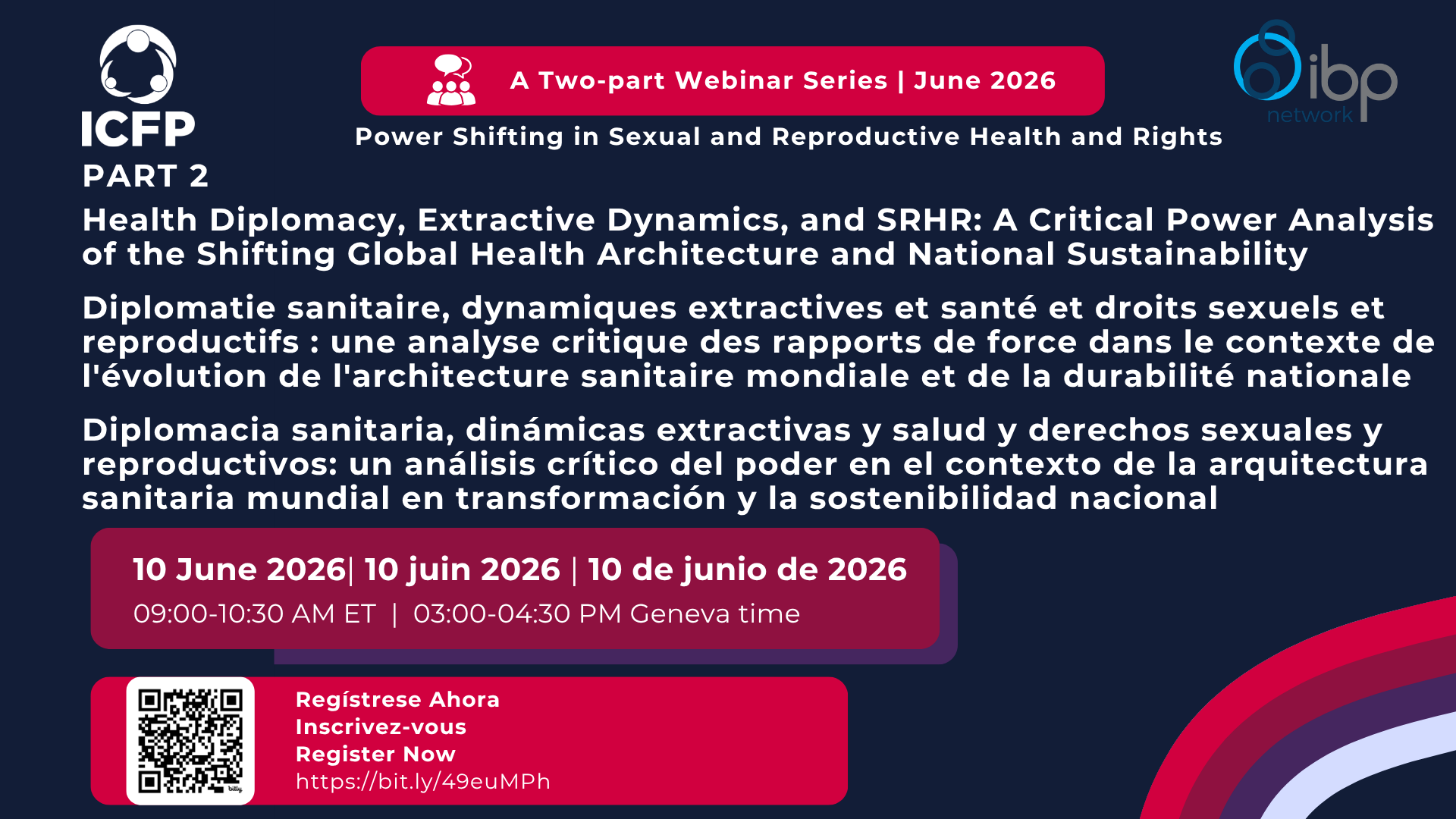
Health agreements are rarely what they seem. Behind every bilateral and multilateral health partnership lies a power struggle-where terms are negotiated unequally, donor interests often override national priorities, and the consequences for sexual and reproductive health and rights (SRHR) can be severed. This webinar will critically examine power dynamics in global health diplomacy through a power-shifting lens, interrogating how extractive bilateral and multilateral health agreements reproduce inequitable relations, constrain SRHR outcomes, affect national sovereignty, and threaten long-term health system sustainability. Drawing on documented examples from across the global health architecture, including health-conditioned agreements, policy restrictions, and funding mechanisms, we will analyze the concrete implications of these dynamics for sexual and reproductive health and rights in low- and middle-income countries.
Bringing together perspectives from legal scholars, policy experts, civil society leaders, and global health practitioners, the discussion will explore how geopolitical shifts, structural power imbalances, and donor priorities shape the terms of health engagement. Speakers will draw on their expertise in health diplomacy, U.S. policy advocacy, and monitoring of health agreements to illuminate the mechanisms through which extractive dynamics operate and their direct impacts on SRHR, health equity, and national agency.
Participants will also engage with broader conversations around alternative approaches to health diplomacy, the role of South-South cooperation, locally-driven solutions, and strategies for advancing equitable, justice-centered approaches to health and rights that strengthen rather than undermine national health systems and development goals.
What to Expect;
- Critical analysis of power dynamics in health diplomacy and their implications for SRHR and national sustainability
- Discussion of policy conditionalities (including the Global Gag Rule and other restrictions) within the context of broader health agreements
- Examination of extractive dynamics across bilateral and multilateral health agreements, with specific examples
- Insights on how countries and civil society can assert greater agency in health diplomacy negotiations
- Interactive dialogue on advocacy priorities and locally-driven alternatives to extractive models of engagement
We hope you will be able to join us for this timely and important conversation.