
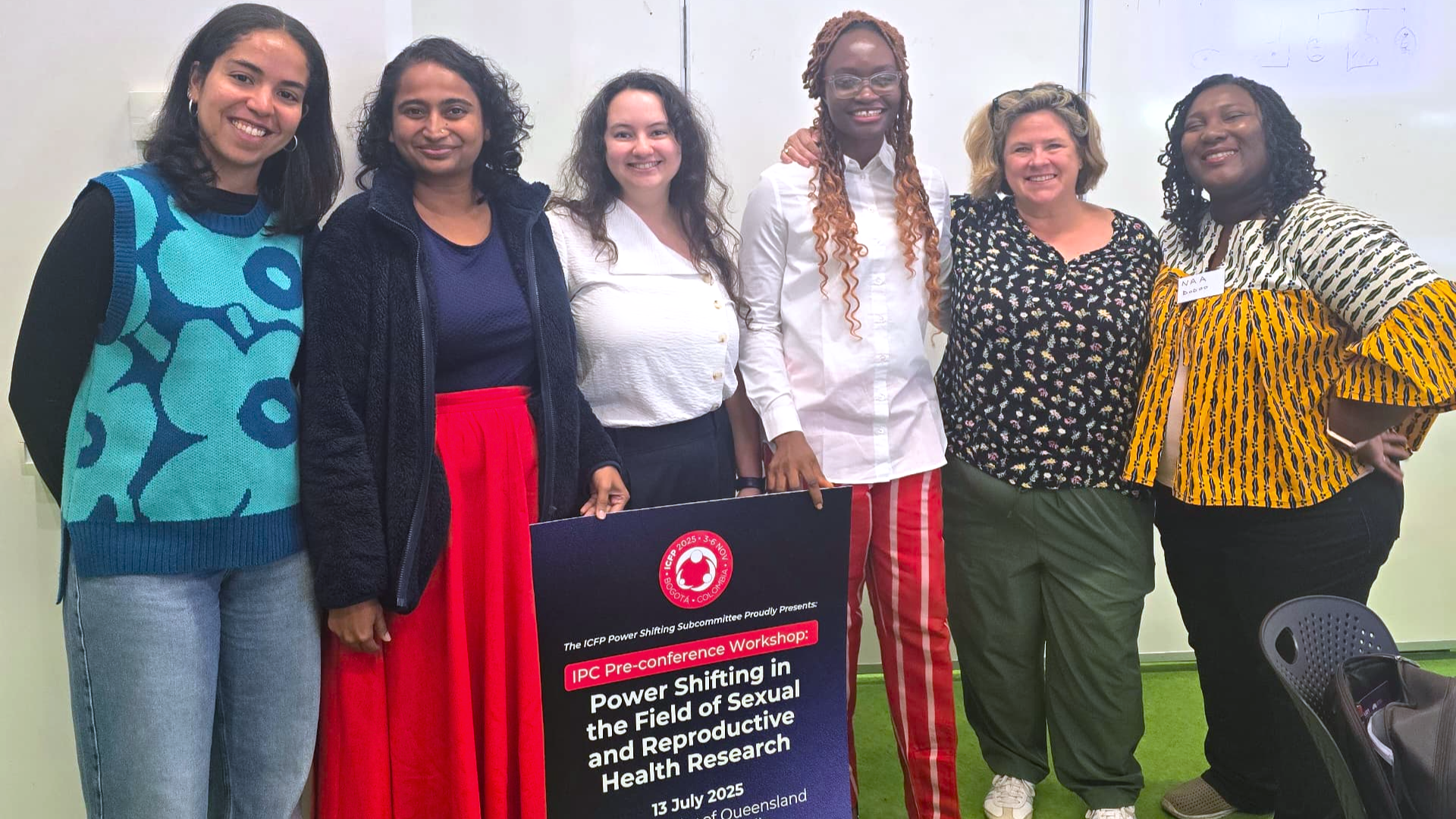
Key Insights from the International Population Conference (IPC2025) Power Shifting Pre-conference
On 13 July 2025, researchers, practitioners, policymakers, and funders gathered at The University of Queensland in Brisbane, Australia for a crucial conversation about transforming power dynamics in sexual and reproductive health and rights (SRHR) research to kick off the 30th International Population Conference (IPC2025). This pre-conference, hosted by the ICFP 2025 Power Shifting Subcommittee, brought together voices from across the globe to address one of the most pressing challenges in our field: how do we move beyond extractive research models toward genuinely equitable partnerships?
The Journey to Power Shifting
The conversation around power shifting in population science hasn’t emerged overnight. As pre-conference organizer Goodness Ogeyi Odey outlined, this movement has been building momentum across multiple international platforms. From the foundational discussions at ICFP 2022 in Pattaya City, Thailand, to the discuss on power dynamics in research development and partnerships held at the Population Association of America Annual meeting (PAA2023) in Louisiana, USA; to multilingual conversations at the African Population Conference (APC2024) in Malawi that demonstrated power sharing through language accessibility, the field has been gradually awakening to the need for fundamental change.
The timing of this Brisbane gathering was particularly poignant. As Odey noted, “This year has had many disruptions, especially for those who work in sexual and reproductive health.” These disruptions have only amplified the urgency of addressing structural inequities in how research is conducted, funded, and disseminated.
Data Sovereignty in Crisis: The DHS Dilemma
One of the most compelling sessions focused on data sovereignty and the precarious future of major demographic surveys moderated by Dr. Philip Anglewicz, Director of the William H. Gates Sr. Institute for Population and Reproductive Health (WHGI). The uncertainty surrounding the Demographic and Health Surveys (DHS) program served as a critical reminder of how dependent the field has become on centralized, donor-funded data systems.
Dr. Onikepe Owolabi, Vice President for International Research at the Guttmacher Institute raised fundamental questions that cut to the heart of current power imbalances: “Who determines what aspects of SRHR data are important to national governments? Who determines what modules should go into subsequent surveys, and who owns this data?”
While countries technically “own” DHS data, they have little say in what gets collected or how surveys are designed. This contradiction exposes the performative nature of current data ownership models. As one participant noted, if asked whether they could independently own and run data collection, many countries would say no—highlighting the expertise dependency that perpetuates these power imbalances.
Three Critical Dimensions of Change
The pre-conference’s breakout sessions revealed three interconnected areas requiring urgent attention:
1. Vulnerability and Infrastructure Resilience
Current SRHR data systems are alarmingly vulnerable to political and funding shifts. Participants identified several interconnected risks that threaten the field’s foundation. Credibility gaps emerge when researchers struggle to convince policymakers of issues’ severity without robust data backing their arguments.
Meanwhile, legitimacy questions persist around whether to trust locally generated data versus internationally standardized surveys, revealing deep-seated assumptions about whose knowledge counts. Perhaps most critically, the overreliance on donor priorities that may not align with local needs creates a fundamental dependency that undermines genuine country ownership.
The solution isn’t simply securing more funding but rather fundamentally rethinking data infrastructure from the ground up, with countries positioned firmly at the center of decision-making processes. We also want to question to what end data is being collected: how do we avoid selective data collecting?
2. Governance and Co-Ownership Models
True power shifting requires moving far beyond rhetoric about country ownership toward concrete structural changes. Participants grappled with practical questions that cut to the heart of current arrangements: What would genuine co-ownership actually look like in practice? How can essential data remain accessible to the global research community while simultaneously respecting national sovereignty and local priorities
The challenge lies in building entirely new governance structures that don’t simply replicate existing power imbalances under different institutional names. This transformation demands moving beyond tokenistic consultation processes toward meaningful shared control over research priorities, methodological choices, and resource allocation decisions.
3. Methodological Innovation and Epistemological Diversity
Perhaps most fundamentally, the field must critically examine its deeply embedded methodological assumptions. While quantitative approaches provide valuable insights, their dominance has created significant blind spots that only qualitative and mixed-methods approaches can effectively address.
As one participant astutely observed, “We talk about national level, but from an equity perspective, we should talk about sub-national level as well.” The field’s historical focus on married women of reproductive age, for instance, has created what participants described as “many silences from men, older women, adolescents, sexual health, pleasure.”
The pre-conference discussion called for actively challenging “the hierarchy of evidence that we have created” while simultaneously integrating participatory and decolonizing methodologies without sacrificing analytical rigor or empirical validity.
The participants also emphasized the urgent need to challenge methodological orthodoxy that has dominated the field. This involves creating flexibility in both quantitative and qualitative approaches, moving away from rigid survey instruments toward adaptive methodologies that better reflect local priorities and contexts. Such changes require institutional support and revised evaluation criteria that value methodological innovation alongside traditional measures of academic success.
Finally, discussions acknowledged the practical constraints that any new approach must navigate. Participants recognized the significant burden that extensive data collection places on individuals and communities. Any transformed approach must carefully balance comprehensiveness with sustainability while maintaining deep respect for participants’ time and privacy.
Bridging Life-Course Perspectives
A particularly innovative panel session explored the artificial divide between family planning and aging policies. Dr. Naa Dodoo, co-chair of the African Coalition for Research and Communication on Abortion (ACORCA/COARCA) highlighted how donor priorities have historically focused on fertility, neglecting the emerging realities of demographic transition in the Global South.
Prof. Latif Dramani, coordinator of the regional Research Center for Generational Economics (CREG), emphasized the need for “population policies that address the lifecycle and beyond,” noting that African countries are beginning to recognize their demographic potential while simultaneously preparing for future aging populations.
This life-course approach to population research represents a significant departure from narrow, donor-driven priorities toward more holistic, country-led perspectives on demographic wellbeing.
The Path Forward: From Extraction to Partnership
Several key themes emerged for moving the field toward more equitable partnerships and genuine collaboration. The imperative to build and retain local expertise resonated strongly throughout discussions. As Dodoo noted, expertise from developing countries often migrates to Western institutions, creating a persistent brain drain that undermines capacity building efforts. Power-shifting requires not just initial capacity development but creating sustainable conditions for retaining talent within countries where research is conducted.
The need to fundamentally rethink research incentives became equally apparent. Academic researchers must move beyond narrow publication-focused metrics toward research frameworks that genuinely serve public and policy needs. This transformation includes developing stronger communication skills and engaging directly with policymakers and communities rather than limiting engagement to academic circles.
A Global Community of Practice
Perhaps most importantly, the Brisbane pre-conference demonstrated the growing global community committed to these changes. From researchers documenting menstrual health experiences that traditional surveys miss, to policymakers advocating for integrated demographic approaches, to methodologists developing innovative mixed-methods frameworks, change is happening across multiple levels simultaneously.
The challenge now is coordination and acceleration. As the field faces ongoing disruptions—funding uncertainties, political pressures, and changing global health priorities, the window for fundamental transformation may be narrowing.
The conversations in Brisbane made clear that power shifting in SRHR research isn’t just about being more inclusive—it’s about survival. In an era of rising authoritarianism, shrinking civic space, and challenged multilateralism, the field’s credibility and relevance depend on its ability to genuinely serve the communities it studies.
This transformation won’t happen through good intentions alone. It requires concrete changes in funding mechanisms, governance structures, methodological approaches, and career incentives. Most importantly, it requires sustained commitment from all stakeholders – researchers, funders, policymakers, and communities—to do the hard work of rebuilding research relationships on more equitable foundations.
The power shifting pre-conference provided a roadmap. The question now is whether the field has the collective will to follow it.
The IPC2025 Power Shifting Subcommittee Pre-conference was organized by the International Conference on Family Planning (ICFP) and held at The University of Queensland, Brisbane, Australia on 13 July 2025. The event brought together researchers, practitioners, policymakers, and funders from around the world to explore frameworks for equitable partnerships in sexual and reproductive health research.